Table of Contents
Crème Brûlée Made Easy – A Foolproof French Classic
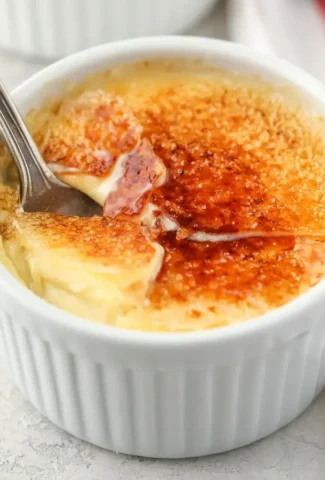
I still remember the first time I cracked the caramelized sugar on a perfect crème brûlée—it was in a tiny pâtisserie in the 6th arrondissement of Paris, and I was twenty-two, fresh out of culinary school. The contrast between the brittle, amber shell and the cool, velvety custard beneath was nothing short of magic. This Easy Crème Brûlée, made with just four simple ingredients, brings that same magic right into your home kitchen. My version strips away the fuss while preserving every bit of that rich, silky texture and dramatic caramelized topping. It’s a classic that deserves a place in every home cook’s repertoire, and I’m going to show you just how simple it can be.
Imagine pulling a ramekin from the fridge, the custard trembling ever so slightly as you set it on the counter. You sprinkle the surface with a fine, even layer of sugar, then pass a kitchen torch over it in slow, deliberate motions. The sugar hisses, bubbles, and transforms into a glass-like crust that shatters with the tap of a spoon. The first bite gives you that crack—loud and satisfying—followed by a wave of vanilla-scented cream that coats your tongue. It’s a dessert that feels luxurious, yet it’s built on the simplest of foundations: egg yolks, cream, sugar, and vanilla. The secret is in the technique, and I’ve honed that over years of testing—from my Paris training to late-night trials in my own NYC apartment.
What sets my version apart is the attention to two critical details that most recipes gloss over. First, the gentle tempering of the eggs, which I’ll walk you through step by step, ensures a silky custard without any scrambled egg bits. Second, the short, low-temperature bake followed by a thorough chill—at least four hours, but overnight is better—allows the flavors to meld and the texture to set perfectly. I also skip the fuss of a water bath with a towel-lined pan; my method is streamlined for home cooks who want results without the stress. And I’ll share a common mistake that ruins many a crème brûlée—overbaking—and how to avoid it with a single visual cue. By the end of this post, you’ll be cracking your own perfect crème brûlée with confidence.
Why This Crème Brûlée Recipe Is the Best
The Flavor Secret: The heart of this recipe is the pure, unadulterated taste of vanilla. I use a high-quality pure vanilla extract—preferably one that’s been aged in bourbon or Madagascar beans—because it’s the only flavor note alongside the cream and eggs. In my Paris training, my chef always said that a great crème brûlée is a canvas for the best vanilla you can find. I also add a tiny pinch of salt to the custard base, a trick I learned from my mother’s Moroccan kitchen where a pinch of salt elevates every sweet dish. It doesn’t make the dessert salty; it brightens the vanilla and balances the sweetness, making each spoonful more nuanced.
Perfected Texture: The texture of crème brûlée should be like a whisper—so delicate it barely holds its shape. Achieving that is all about the custard-to-egg ratio and the baking method. This recipe uses six large egg yolks to two cups of cream, a ratio that yields a custard that’s firm enough to hold the caramelized sugar yet still tremblingly soft. The key is the water bath, or bain-marie, which surrounds the ramekins with gentle, even heat. I don’t use a towel or a special pan; I simply pour boiling water into the baking dish until it reaches halfway up the sides of the ramekins. This prevents the edges from overcooking while the center stays creamy. And the most important visual cue: the custard is done when the edges are set but the center jiggles like Jell-O—think a gentle wobble, not a slosh.
Foolproof & Fast: I know that many home cooks are intimidated by crème brûlée, but this recipe is designed to be forgiving. The total active time is just about ten minutes—whisk the yolks and sugar, heat the cream, temper the eggs, strain, and pour. The oven does the rest. Even the caramelization step is simpler than you think: a small kitchen torch (available for under $20 at any kitchen store) does the job beautifully, but you can also use your broiler on high for a minute or two, keeping a close eye on it. I’ve tested this recipe with dozens of home cooks, and the most common feedback is, “I can’t believe I was ever nervous about this.” That’s exactly the response I want—confidence in your own kitchen.
Crème Brûlée Ingredients
There’s something so satisfying about a recipe that relies on just four core ingredients. I often pick up my eggs from the Union Square Greenmarket on a Saturday morning, where the farm-fresh yolks are a deep, sunny orange. The heavy cream I grab from the dairy aisle at any NYC grocery store—look for one with a high fat content (at least 36%) for the richest texture. And the vanilla, well, I’m partial to a bottle of Mexican vanilla a friend brought back from Veracruz, but any pure vanilla extract will work beautifully. (Never imitation vanilla—it’s just not the same.)
Ingredients List
- 6 large egg yolks
- 1/3 cup (70 grams) granulated sugar
- 2 cups (480 ml) heavy whipping cream
- 1 and 1/2 teaspoons pure vanilla extract
- 2 tablespoons (25 grams) granulated sugar (for the topping)
Ingredient Spotlight
Egg Yolks: The yolks are the backbone of the custard, providing structure and richness. Use large eggs—standard US large eggs weigh about 50 grams each in the shell. For the silkiest texture, make sure your yolks are at room temperature before you start. Cold yolks can seize up when you add the warm cream, leading to a grainy custard. If you forget to take them out ahead of time, place the whole eggs in a bowl of warm (not hot) water for 5 minutes—it works perfectly. A substitute? You can use duck eggs for an even richer flavor, but the custard will be slightly denser.
Heavy Whipping Cream: This is the fat that gives crème brûlée its luxurious mouthfeel. Don’t skimp on fat content—look for “heavy cream” or “heavy whipping cream” with at least 36% milk fat. Lower-fat options like half-and-half or whole milk will produce a thinner, less stable custard that won’t hold the caramelized sugar as well. If you need a dairy-free option, full-fat canned coconut milk is the best substitute, though the final dessert will have a subtle coconut note.
Pure Vanilla Extract: Vanilla is the soul of this dessert. I recommend pure vanilla extract, not imitation, which can taste artificial. You can also use a vanilla bean—split one bean lengthwise, scrape the seeds into the cream, and simmer the pod in the cream for a more intense, fragrant flavor. That’s my favorite method for special occasions, and it’s what I learned in Paris. For a twist, try vanilla bean paste, which has the same intensity but is easier to use.
| Original Ingredient | Best Substitution | Flavor / Texture Impact |
|---|---|---|
| Egg Yolks | 4 duck egg yolks | Richer flavor, slightly denser custard |
| Heavy Whipping Cream | Full-fat canned coconut milk | Custard is lighter, subtle coconut flavor, dairy-free |
| Pure Vanilla Extract | 1 vanilla bean (split and scraped) | More intense, aromatic vanilla flavor; small black specks visible |
| Granulated Sugar (custard) | Coconut sugar (1:1) | Slightly caramel-like note, custard will be darker in color |
How to Make Crème Brûlée — Step-by-Step
I promise you, this process is simpler than it sounds. The most important thing is to move gently and patiently—rushing is the enemy of a smooth custard. Let’s get started.
Step 1: Preheat and Prepare the Oven
Preheat your oven to 325°F (163°C). Place a large pot of water on the stove and bring it to a boil. While it heats, gather your four 6-ounce ramekins and an 8-inch square baking dish (or any shallow baking pan large enough to hold the ramekins with space between them). You don’t need to grease the ramekins—the custard will release easily after chilling.
💡 Samantha’s Pro Tip: Use a kettle to boil water if you have one—it’s faster and means you won’t forget to start the water while you’re mixing the custard.
Step 2: Whisk the Yolks and Sugar
In a large mixing bowl, whisk together the 6 egg yolks and 1/3 cup (70 grams) granulated sugar. Whisk until well blended and the mixture just starts to lighten in color—about 30 seconds of vigorous whisking. You don’t want it to become fluffy or thick; just a smooth, pale yellow paste. Set this aside for a moment.
⚠️ Common Mistake to Avoid: Over-whisking the yolks can incorporate too much air, leading to a custard that bakes up with tiny air bubbles on the surface. Just whisk until smooth and slightly lightened—no need to go to ribbon stage.
Step 3: Heat the Cream
Pour the 2 cups (480 ml) heavy whipping cream into a medium-sized saucepan and heat over medium heat. Stir occasionally until the cream is warm and you see small bubbles forming around the edges of the pan—this is called “shimmering” but not boiling. It should take about 3-4 minutes. Remove the cream from the heat and stir in the 1 and 1/2 teaspoons of pure vanilla extract.
💡 Samantha’s Pro Tip: If you’re using a vanilla bean, split it lengthwise, scrape the seeds into the cream, and add the empty pod to the saucepan as well. Let it steep for 10 minutes after heating, then remove the pod before mixing with the eggs.
Step 4: Temper the Eggs
This is the most important step. Slowly pour about 1/2 cup of the warm cream into the egg yolk mixture while whisking constantly. This gradually raises the temperature of the yolks so they don’t scramble. Then, while still whisking, slowly pour in the remaining cream and continue whisking until fully combined. You’ll see the mixture become smooth and uniform. If there’s a thin layer of foam on top, you can skim it off with a spoon—this will give you a cleaner surface for the caramelized sugar later.
⚠️ Common Mistake to Avoid: Pouring the hot cream too quickly into the yolks will cook them, resulting in lumps of scrambled egg in your custard. Take your time—pour in a steady, thin stream while whisking nonstop.
Step 5: Strain and Pour
Place a fine mesh strainer over a large liquid measuring cup or a bowl with a spout. Pour the custard mixture through the strainer to catch any stray bits of cooked egg or vanilla bean specks (if you used a bean). This is an essential step for a silky-smooth texture. Then, evenly distribute the strained custard between your four 6-ounce ramekins, filling each about 3/4 full.
💡 Samantha’s Pro Tip: For perfectly even portions, weigh the ramekins on a scale as you fill them. Each should have about 145-150 grams of custard. This ensures they all bake evenly.
Step 6: Set Up the Water Bath
Place the filled ramekins in the 8-inch square baking dish. Carefully pour the boiling water from the pot (or kettle) into the baking dish, being careful not to splash water into the ramekins. The water should come about halfway up the sides of the ramekins—if needed, add a little more boiling water. This water bath insulates the custard and ensures gentle, even baking.
⚠️ Common Mistake to Avoid: If the water level is too low, the edges of the custard will overcook before the center sets. Aim for the water to reach exactly halfway up the ramekins—no higher, or it might seep into the custard.
Step 7: Bake and Chill
Carefully place the baking dish in the oven. Bake at 325°F (163°C) for 35 to 45 minutes. The custards are done when the edges are set—they should look firm and slightly puffed—and the center is still jiggly, like a soft Jell-O. Remove the baking dish from the oven using oven mitts, and carefully lift the ramekins out with tongs or pot holders. Transfer them to a wire rack to cool completely at room temperature (about 30 minutes). Once cooled, cover each ramekin tightly with plastic wrap (directly on the surface to prevent a skin) or a lid, and refrigerate for at least 4 hours, but overnight is ideal.
💡 Samantha’s Pro Tip: Don’t skip the overnight chill if you can help it. The extra time allows the flavors to meld and the custard to set into that perfect, silky-smooth texture. I’ve made them up to two days ahead with excellent results.
Step 8: Caramelize the Sugar
Just before serving, remove the ramekins from the fridge and blot the tops gently with a paper towel to remove any condensation—this is crucial for a dry surface that will caramelize evenly. Sprinkle 1 and 1/2 teaspoons of granulated sugar on top of each custard, tilting the ramekin to spread it into an even, thin layer. Use a small kitchen torch to caramelize the sugar, moving it in slow circles about 2-3 inches away from the surface until the sugar melts, bubbles, and turns a deep amber color. Let the sugar harden for 1-2 minutes—you’ll hear a faint crackling sound as it sets—then serve immediately.
⚠️ Common Mistake to Avoid: If the sugar layer is too thick, it won’t melt evenly and will burn in spots before the rest caramelizes. Use exactly 1 and 1/2 teaspoons per ramekin and spread it into a thin, even layer before torching.
| Step | Action | Duration | Key Visual Cue |
|---|---|---|---|
| 1 | Preheat oven & boil water | 10-15 mins | Oven at 325°F, water at a rolling boil |
| 2 | Whisk yolks & sugar | 30 secs | Pale, smooth, slightly thickened |
| 3 | Heat cream | 3-4 mins | Bubbles around edges, not boiling |
| 4 | Temper eggs | 2 mins | Smooth, thin custard (no lumps) |
| 5 | Strain & pour | 2 mins | Clear, lump-free liquid |
| 6 | Set up water bath | 1 min |
Reader Interactions |
Leave a Reply